Colin Bridgerton's Grand Tour Collection: A Virtual Exhibition
(Published on Reddit on 1 June 2025)
Preface:
A few weeks ago, I posted the route of Colin Bridgerton's second Grand Tour on Reddit (https://www.reddit.com/r/PolinBridgerton/comments/1k5q0j0/the_real_colin_bridgerton_route/). In that post, I promised a detailed explanation of why this was likely Colin's chosen travel route. The explanation turned out to be so extensive that I decided to divide it into two separate parts:
Part 1: Colin Bridgerton's Grand Tour Collection,
Part 2: Further evidence for Colin Bridgerton's itinerary (coming soon).
Introduction:
A person's home and the objects they surround themselves with can tell us a lot about them. This post examines the objects that the set decoration department of the TV series Bridgerton used to decorate Colin Bridgerton's home in Bloomsbury, as seen in season 3, and what they reveal about Colin and his travels. At the beginning of season 3, Colin returns from his second Grand Tour. A Grand Tour was an educational journey through continental Europe that could last from a few months to several years. Grand Tours served as an important rite of passage for young English aristocrats. They were undertaken from the late 16th century until the expansion of railways in Europe around 1830, with their heyday being the Age of Enlightenment.
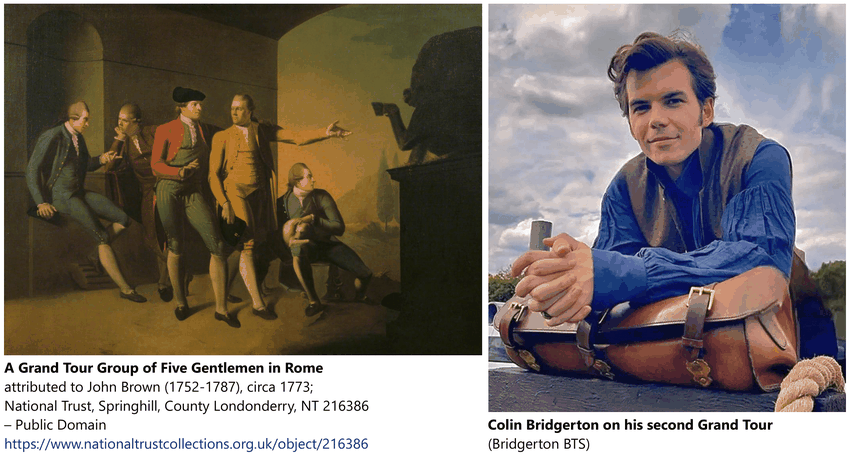
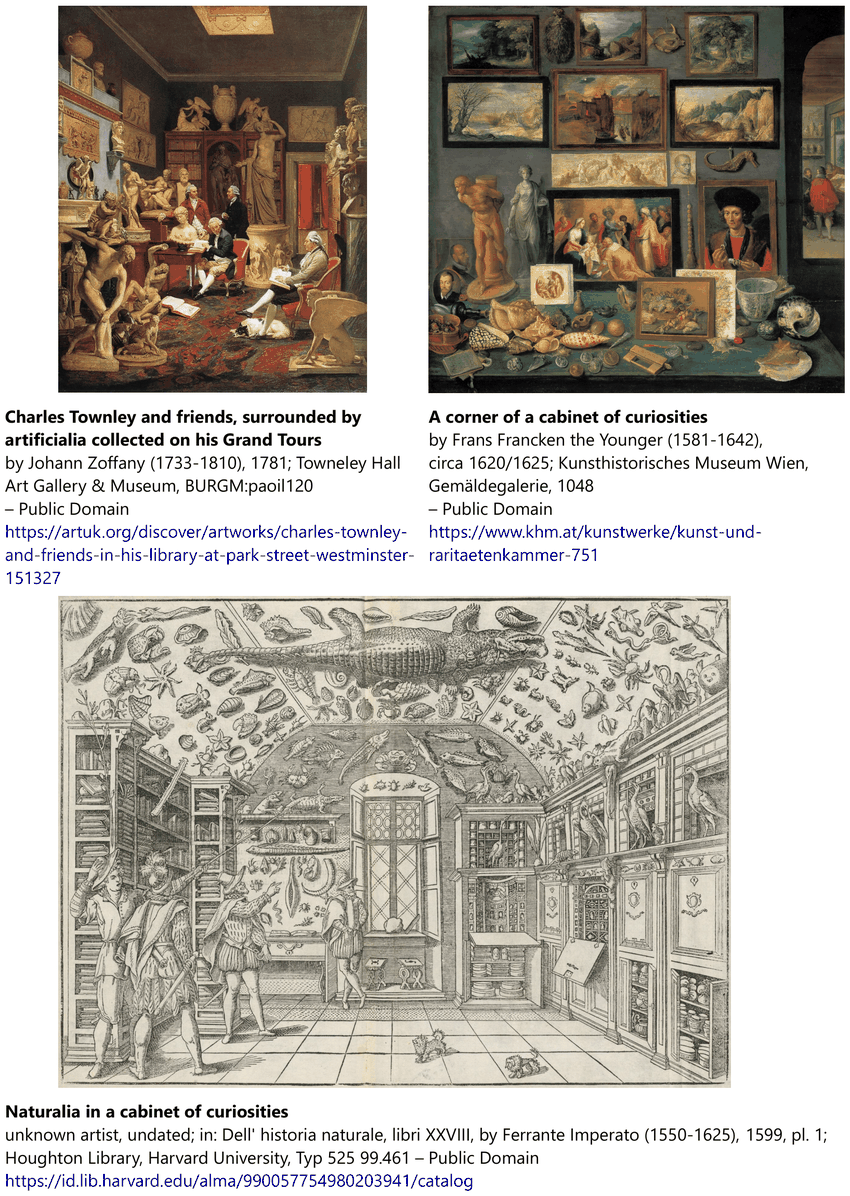
To demonstrate the education they had acquired at domestic institutions and abroad, as well as to prove the number of places they had visited, Grand Tourists used to bring home a wide variety of objects. For this reason, there was a thriving market for small-format paintings of famous sights and (miniaturised) replicas of well-known archaeological artefacts. Craftsmen produced thousands of these as souvenirs. Although souvenirs of the Grand Tour were mass-produced, they became popular collectibles because large-format paintings and genuine antiquities such as original vases, statues, and bronzes were available to only a few travellers. Those who could afford it decorated their homes with a so-called Grand Tour Collection, reminiscent of earlier cabinets of curiosities or wonder-rooms (Wunderkammern). The Grand Tour Collections of Thomas Hope (1769-1831), John Soane (1753-1837), and Charles Townley (1737-1805), for example, are still famous today due to their uniqueness and scale.
A complete Grand Tour Collection usually consisted of components from the following three categories:
1. Naturalia (rare and precious products of nature). The classification of natural products as rare and precious primarily depended on the opinion of the collector's peer group. Occasionally, however, a Grand Tour Collection also included naturalia that were only of great value to the collector himself, for example, due to sentimental significance, such as the hunting trophy from the first animal shot or the skull of a particularly victorious or loyal horse. Exotic animals and plants were sometimes regarded as a distinct subcategory and called exotica.
2. Artificialia (extraordinary products of man, such as (replicas of) archaeological artefacts and works of art), and
3. Scientifica (testaments of man's ability to dominate nature, such as scientific instruments (microscopes, telescopes, astrolabes, compasses), maps, globes, chronometers, and automatons). Although the topics ‘threats to the diversity of animal and plant species due to hunting or collecting’, ‘colonialism’, and ‘looted art’ are certainly relevant in the context of Grand Tour Collections, they are deliberately omitted here, as the TV series Bridgerton depicts a largely idealised world.
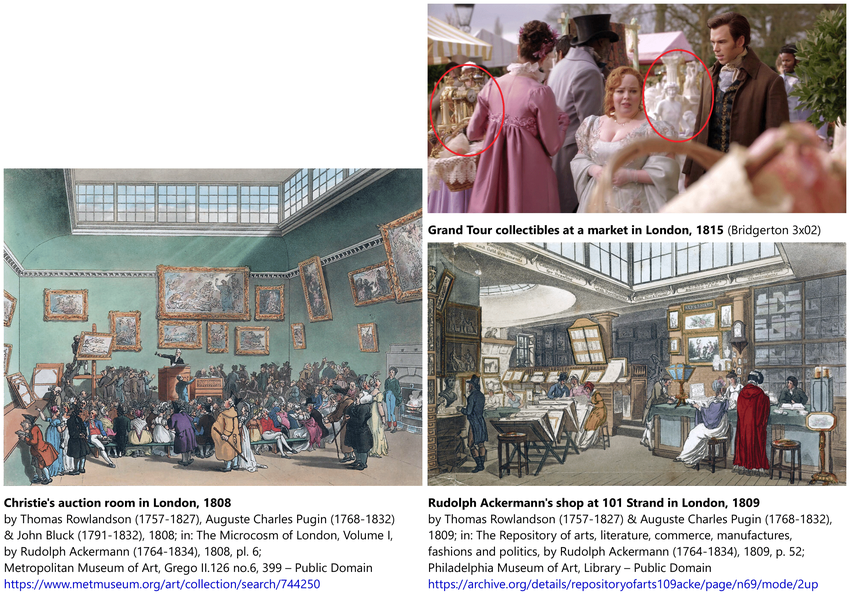
Grand Tour collectibles were prestigious and much sought-after. Consequently, the desire for such objects was also high among those unable to go on a Grand Tour. This led to a significant increase in the commercial import of these objects from the European continent to London, laying the foundation for the city's antiques trade. At the beginning of the 19th century, however, this trade primarily took place in a few auction houses and specialised shops rather than at ordinary markets, as shown in Bridgerton.
Methodology:
This post almost exclusively examines objects that Colin most likely acquired on one of his Grand Tours and that can be considered to be part of a Grand Tour Collection. The following objects were therefore not included:
1. Books, furniture, or other ordinary everyday objects such as mirrors, candleholders, flower vases, fruit bowls, family portraits, etc., which usually would not have been considered as naturalia, artificialia, or scientifica at the beginning of the 19th century,
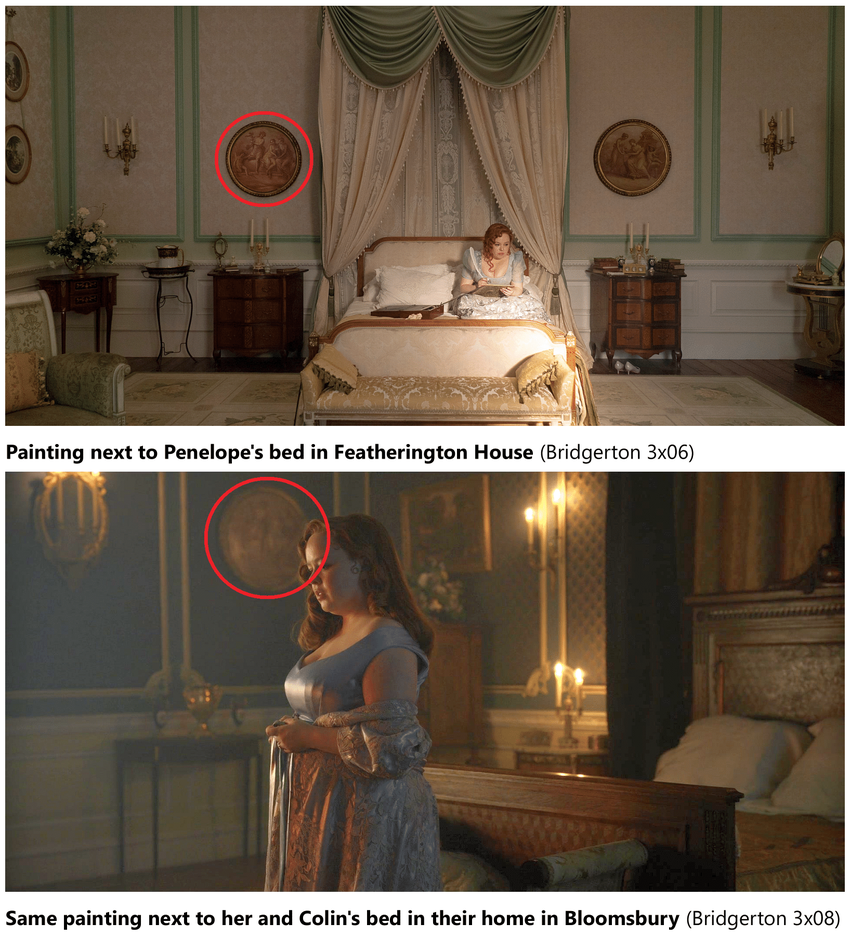
2. Objects belonging to Penelope (though these are few, as a young woman in the early 19th century usually did not bring much more than her trousseau into her marriage and new home). An example of an object that belongs to Penelope is this painting:
3. Objects that can be seen in one of the numerous market scenes in seasons 1-3, because Colin may also have acquired them in London,
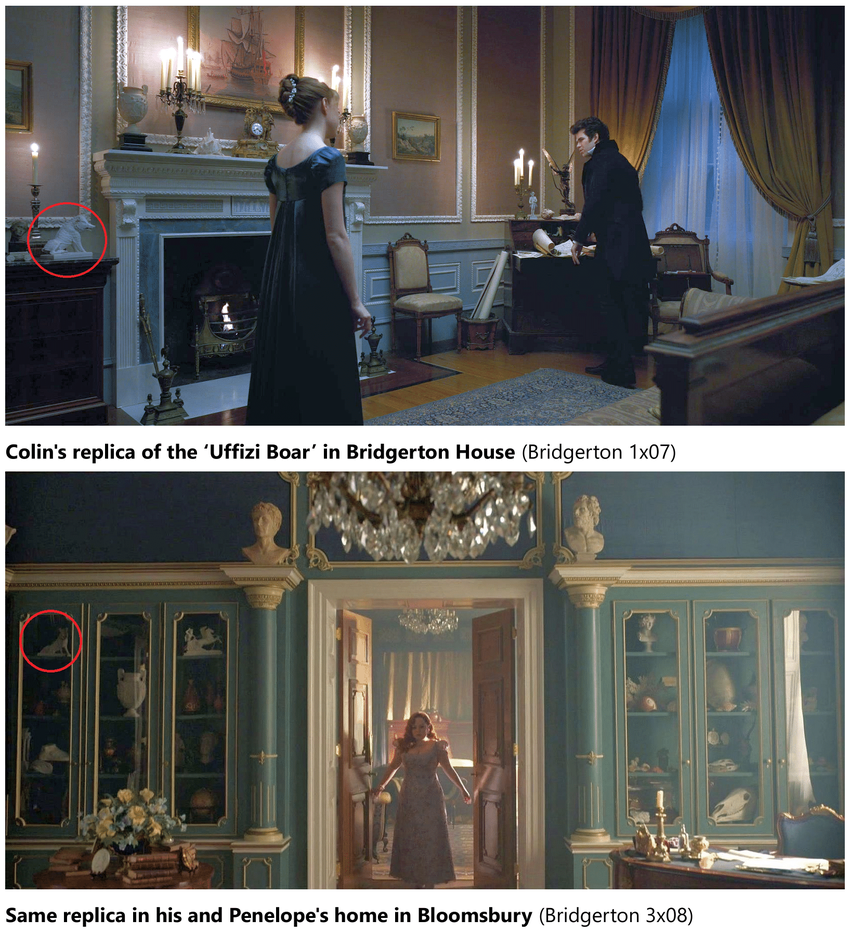
4. Objects that Colin already owned before his first Grand Tour. With one exception, none of these objects have found their way into his home in Bloomsbury. The exception is the following (more on this later):
More than 50 objects in Colin's home in Bloomsbury meet the aforementioned criteria for inclusion. These objects were numbered consecutively, examined from all angles using all available sources (film material, stills, and BTS material), and subsequently identified and classified via reverse image searches, and research in illustrated art books, catalogues from libraries, museums and auction houses, as well as field guides.
The results of my research on the examined objects are presented according to the following structure:
Object:
- Number
- Identifiability: given / not given based on the available sources –
if identifiability is given:
- Name
- Artist / craftsman of the original (artificialia / scientifica)
- Date of origin of the original (artificialia / scientifica)
- Distribution (naturalia).
While I only present originals in this post, it can be assumed that Colin's artificialia (paintings, reliefs, sculptures, busts, statuettes and rare archaeological artefacts) were more likely to be replicas from the 18th and 19th centuries.
Although occasionally spread throughout the entire living space, the presentation of Grand Tour collectibles was often focused on a few selected rooms, frequently those in which guests were received. The parlour (often identical to the drawing room in smaller houses), the drawing room and the cabinet (whose name does not just coincidentally recall the name ‘cabinet of curiosities’) were particularly popular for display and exhibition.
A parlour was a symbol of status and typically the finest room in the entire home. This was where guests whom one wished to impress were received.
The drawing room (derived from ‘to withdraw’) was a space where special guests were taken in order to have more privacy.
A cabinet was a private room that served as a study, office, sitting room or retreat, usually for the man. Only casual guests and close family members were invited here. The cabinet was often decorated with the man's favourite books and works of art, and sited adjacent to his bedchamber.
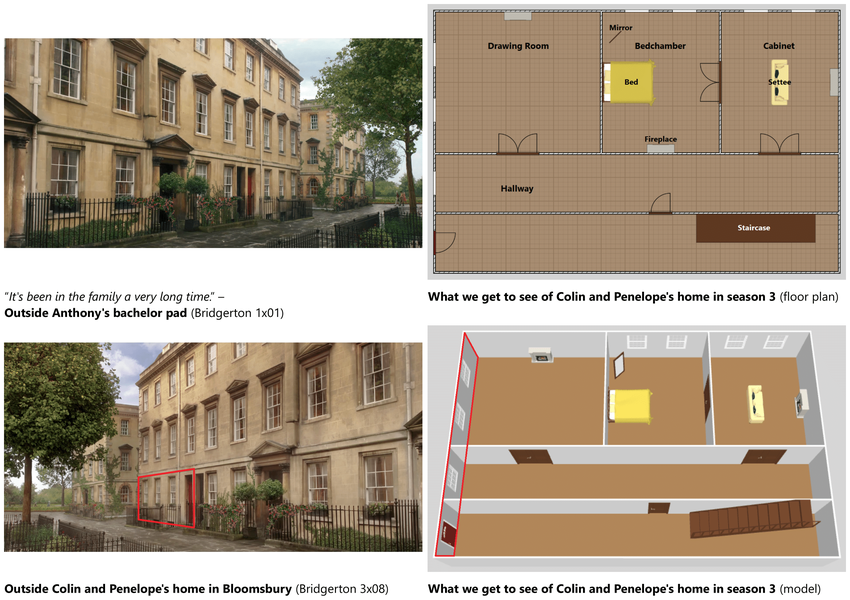
What we get to see of Colin and Penelope's home in season 3 is the hallway, the drawing room, the cabinet, and his or their bedchamber. Fortunately, these are the very rooms where one would expect to find the bulk of Colin's Grand Tour Collection. This virtual exhibition follows the collection from room to room, starting in the drawing room.
Results and hermeneutic interpretation:
Drawing Room
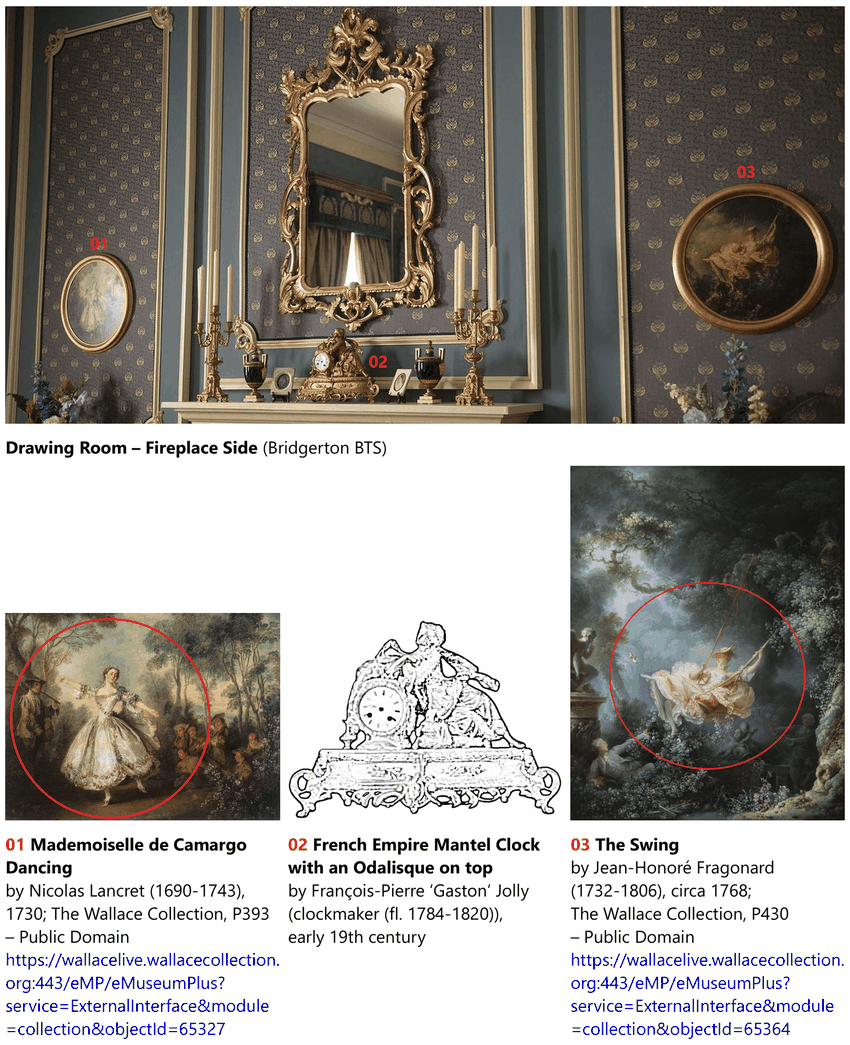
The objects 01-03 are artificialia. They can be considered evidence of Colin's stay in Paris, as they were created by the painters Nicolas Lancret and Jean-Honoré Fragonard, as well as the clockmaker Gaston Jolly, all of whom had worked in Paris.
Object 01 is a cut-out from a painting depicting the famous French dancer Marie Camargo (1710-1770). She is considered to have invented the heelless ballet shoe and the entrechat quatre jump in ballet. Marie Camargo was renowned for being as physically and mentally strong as male dancers. Object 01 is one of the many objects in Colin's Grand Tour Collection that suggest his appreciation for strong women.
Object 02 is a French Empire mantel clock, which, even at the time, was regarded as an objet d'art rather than an everyday object. The clock is adorned with an odalisque. ‘Odalisque’ is a historical term for the concubines in the harem of the Sultan of the Ottoman Empire. In 19th-century art, odalisques were a common subject of depiction. By displaying an odalisque in the drawing room for all to see, Colin demonstrates that he questiones the repressive Christian sexual morality prevailing at the time – an attitude that he probably acquired at the same place where he obtained the mantel clock.
Object 03 is a cut-out from a painting by Jean-Honoré Fragonard. Fragonard's works of art were already widely reproduced during his lifetime and have since been sold as souvenirs in and around Paris. Colin owns at least three such reproductions (see image 11, objects 12 and 13). From ‘The Bridgertons: Happily Ever After’ we know that the artist holds a special significance for the Bridgerton family:
‘The walls [of Aubrey Hall] were still painted the same creamy white, with the barest undertone of peach. And the Fragonard her father had bought her mother for her thirtieth birthday still hung over the table just outside the door to the rose salon. […] Violet stood beside her [Francesca] and together they regarded the Fragonard. “It's marvelous, isn't it?” she murmured, a soft, wistful smile touching her face. “I love it,” Francesca said. “I always have. It makes me think of Father.”’ (in: The Bridgertons: Happily Ever After, When He Was Wicked: The 2nd Epilogue, by Julie Cotler Pottinger a. k. a. Julia Quinn, 2013, pp. 202-203).
Owning three Fragonards suggests that not only Francesca, but also Colin feels a connection to his late father, Edmund Bridgerton, through the artist's paintings.
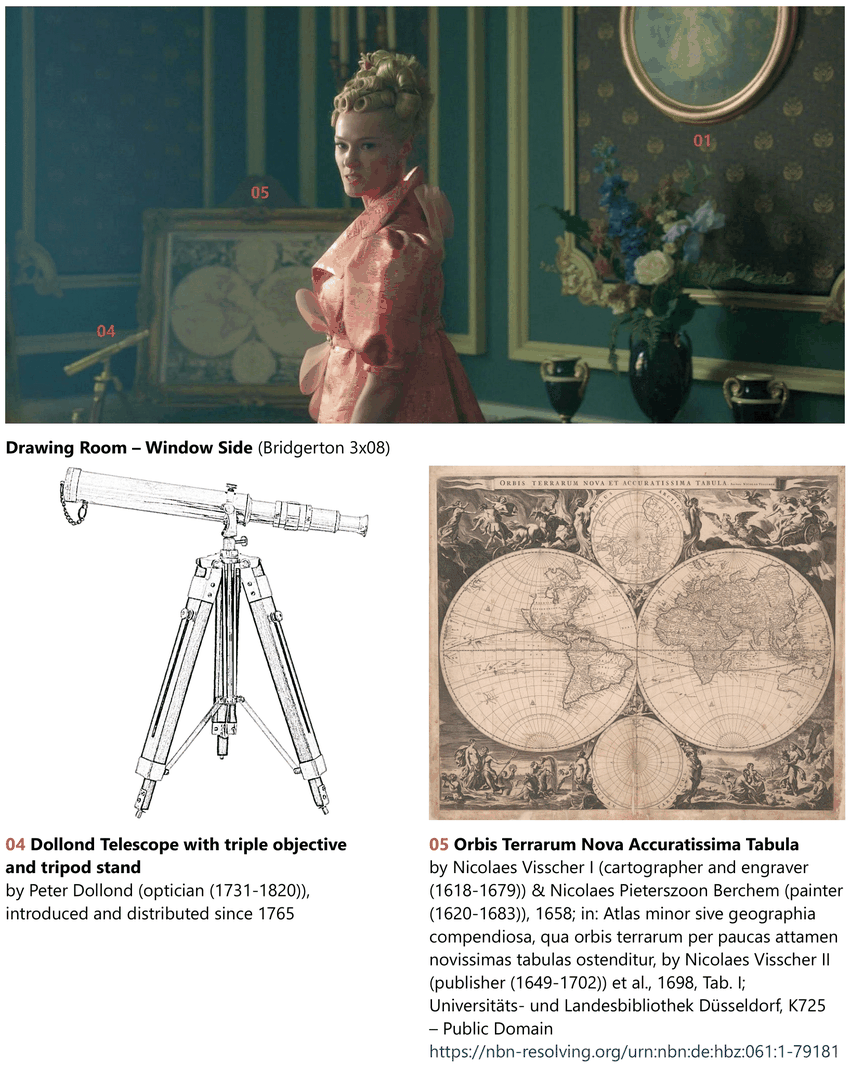
The objects 04-05 are scientifica.
The optician Peter Dollond lived and worked in London. Therefore, it can be assumed that Colin acquired object 04, a Dollond telescope, locally.
Colin probably also bought object 05, a historical world map, in London. There were several maps of this type at the time. What makes this map special is the border decorations, which depict the mythological figures Poseidon, Zeus, Persephone, and Demeter – one of many allusions to Colin's love of ancient Greece.
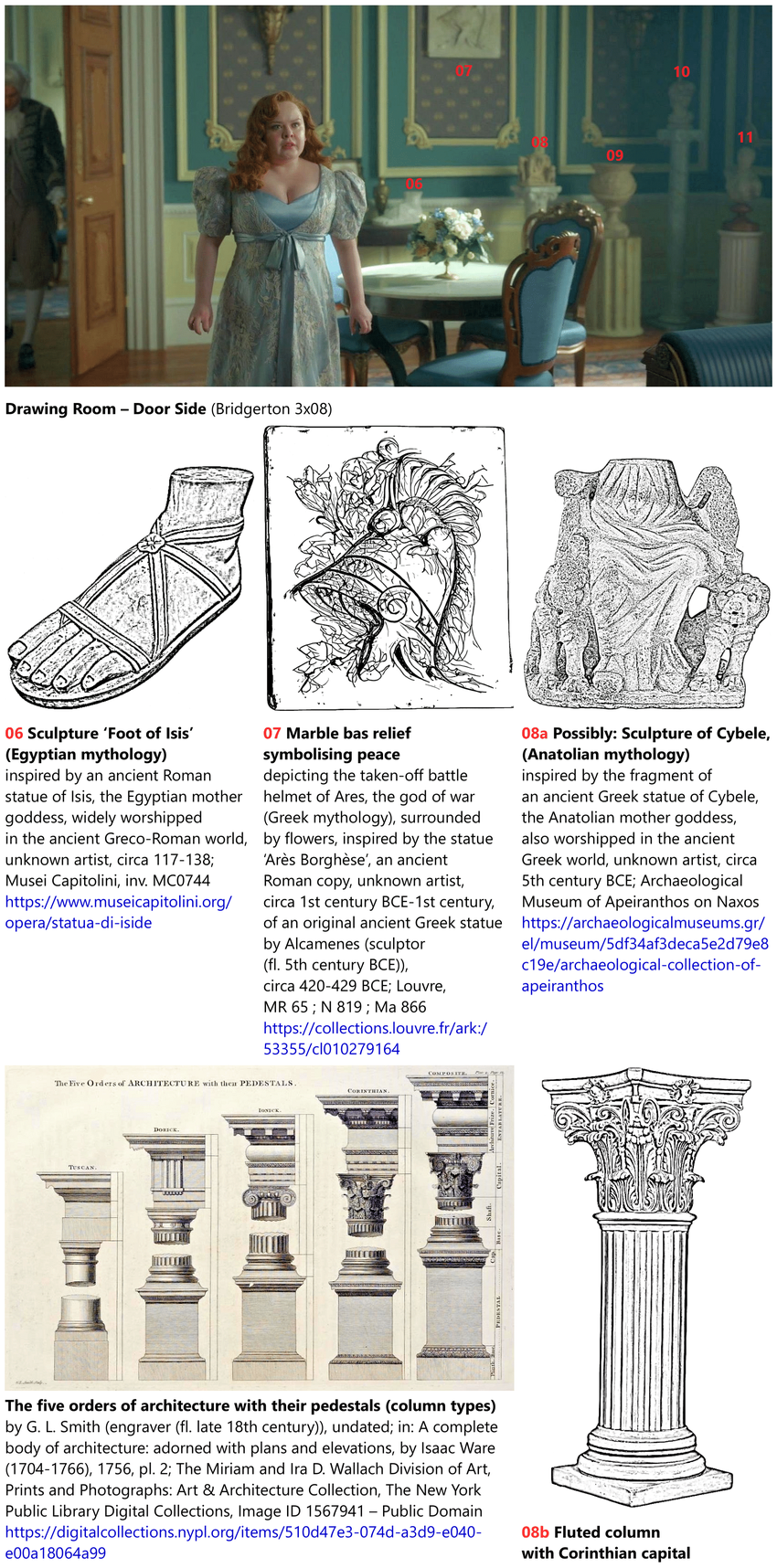
The objects 06, 07 and 08a are artificialia of Roman and Greek origin. Although they give no indication of specific cities where Colin might have stayed, they at least serve as clues to Colin's stay in Greece and present-day Italy.
Object 07 is a relief symbolising peace. Since depictions of Roman battle helmets outside of warlike contexts are rather uncommon, the possession of such a relief could be interpreted as an indication that Colin is a pacifist. Colin seems to like this relief (and possibly its meaning), as he owns two identical copies hanging in different rooms of his home (see image 14, object 7).
Object 06 and possibly also object 08a are both fragments that (could) belong to mother goddesses – a further indication of Colin's appreciation of strong women. However, I am uncertain about the identification of object 08a. Due to its shape and size it is either a fragment or a miniaturised replica of a fragment. Its base is almost square, suggesting the depiction of a throne, temple, or altar. On the right side, the outline of an animal is visible. Based on the spatial proximity to object 06 on the one hand, and on the results of my research on the other hand, my educated guess is that object 08a could be a fragment of a sculpture of Cybele.
All of the objects 08b, 09b, 10b and 11b are Greek columns, despite being combined with objects of different origins.
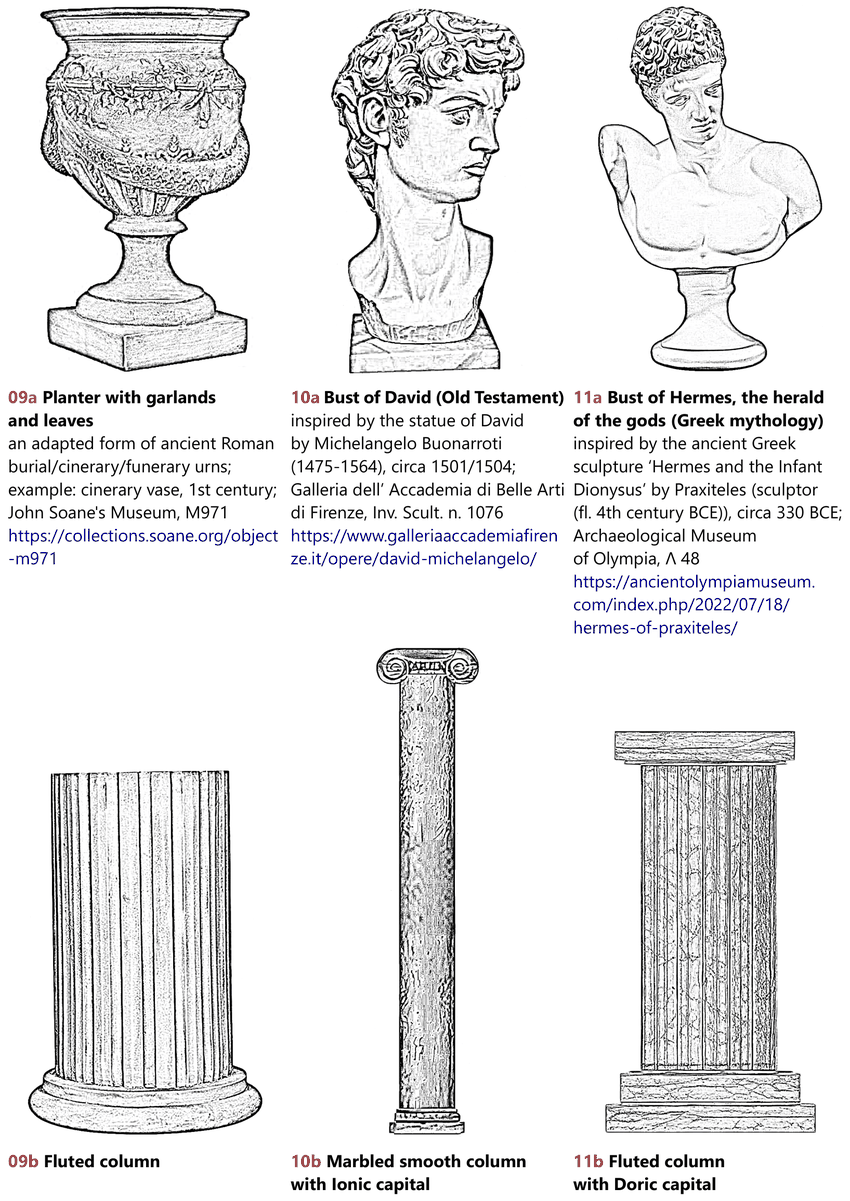
The objects 09a, 10a, and 11a are artificialia. They originate from Greece and present-day Italy.
While the objects 09a and 11a date back to ancient Roman and Greek times, object 10a is of more recent date. It is a bust inspired by the most famous statue in the history of art, Michelangelo's David. Such busts were mainly offered in and around Florence at the beginning of the 19th century, so owning one can serve as evidence of Colin's stay in Florence.
Cabinet
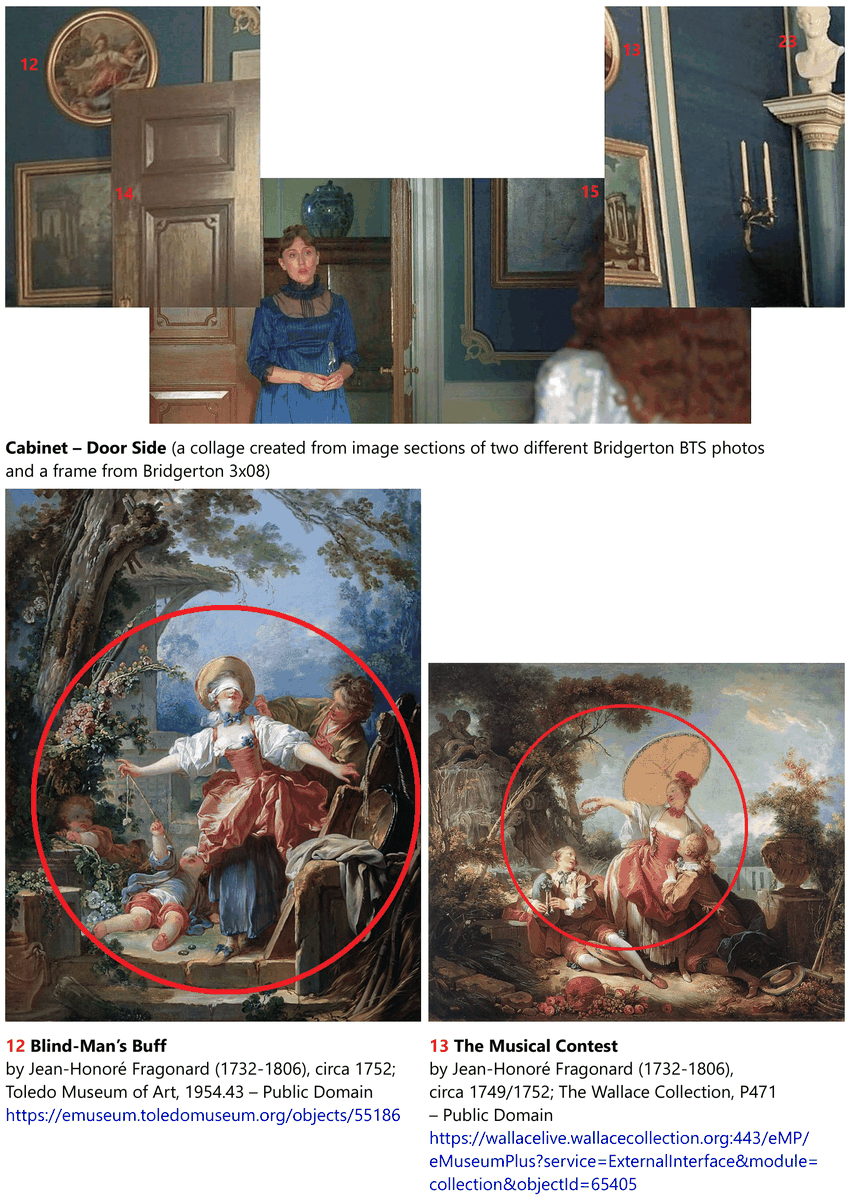
The objects 12 and 13 are artificialia – more precisely, two paintings by Fragonard (see image 07, object 03) – providing further evidence for Colin's stay in Paris and his close connection with his late father.
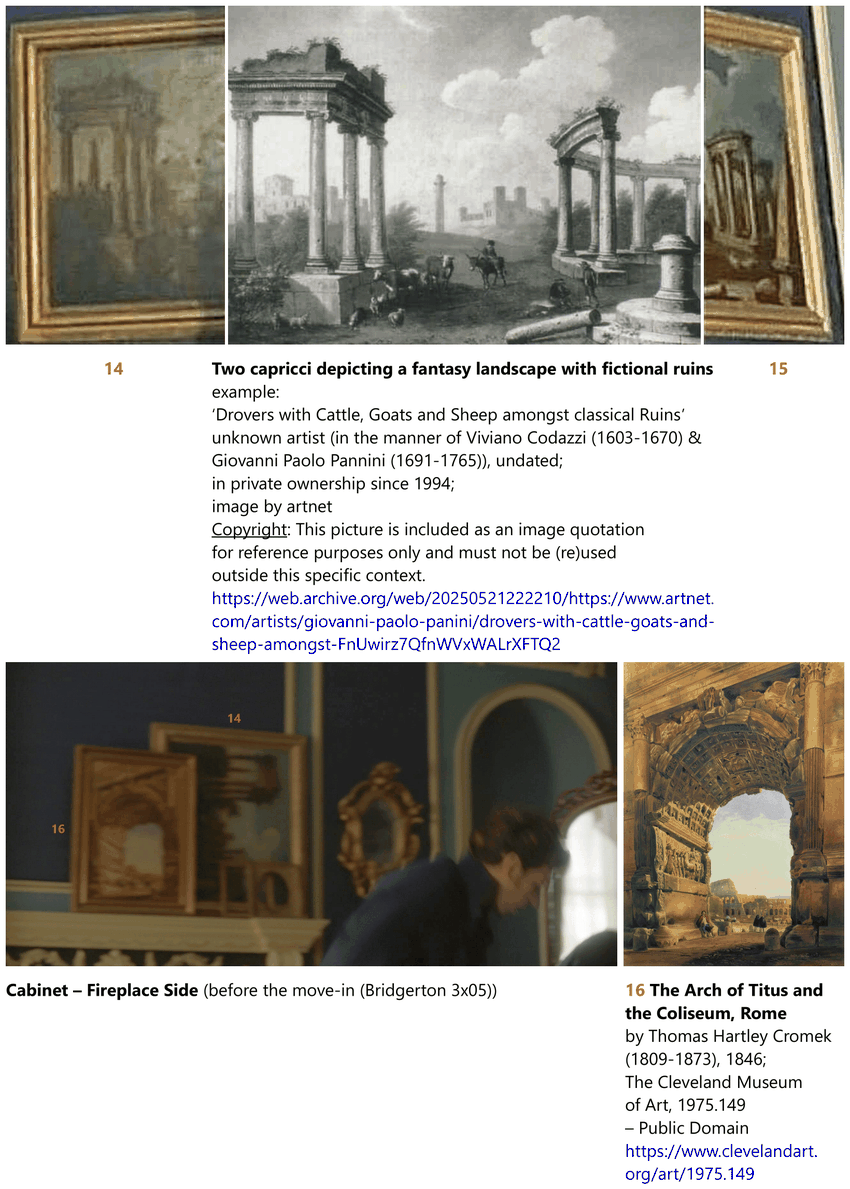
The objects 14-16 are artificialia, all of which serve as proof that Colin was in Rome.
The objects 14 and 15 are two different capricci. Capricci are paintings of fantasy landscapes in which real and/or fictional ruins are arranged in a random manner. Viviano Codazzi and Giovanni Paolo Pannini are among the most famous artists known for such paintings. More or less altered copies of their works of art were sold in Rome as Grand Tour souvenirs since the beginning of the 18th century.
Object 16 is a painting that you can see briefly on the mantelpiece in the cabinet after the so-called Mirror Scene. Its placement after Colin and Penelope's move-in remains unknown. This painting is the first of several minor anachronisms in Colin's Grand Tour Collection, as the original was not created until 1846. However, for all anachronisms, there are historically accurate counterparts of a similar nature, therefore it can be assumed that these anachronistic objects are meant to represent chronologically appropriate pieces (rather than to suggest that Colin was a time traveller). Object 16 is a painting of famous sights of the city of Rome. Such paintings were sold en masse in and around Rome in 1815.
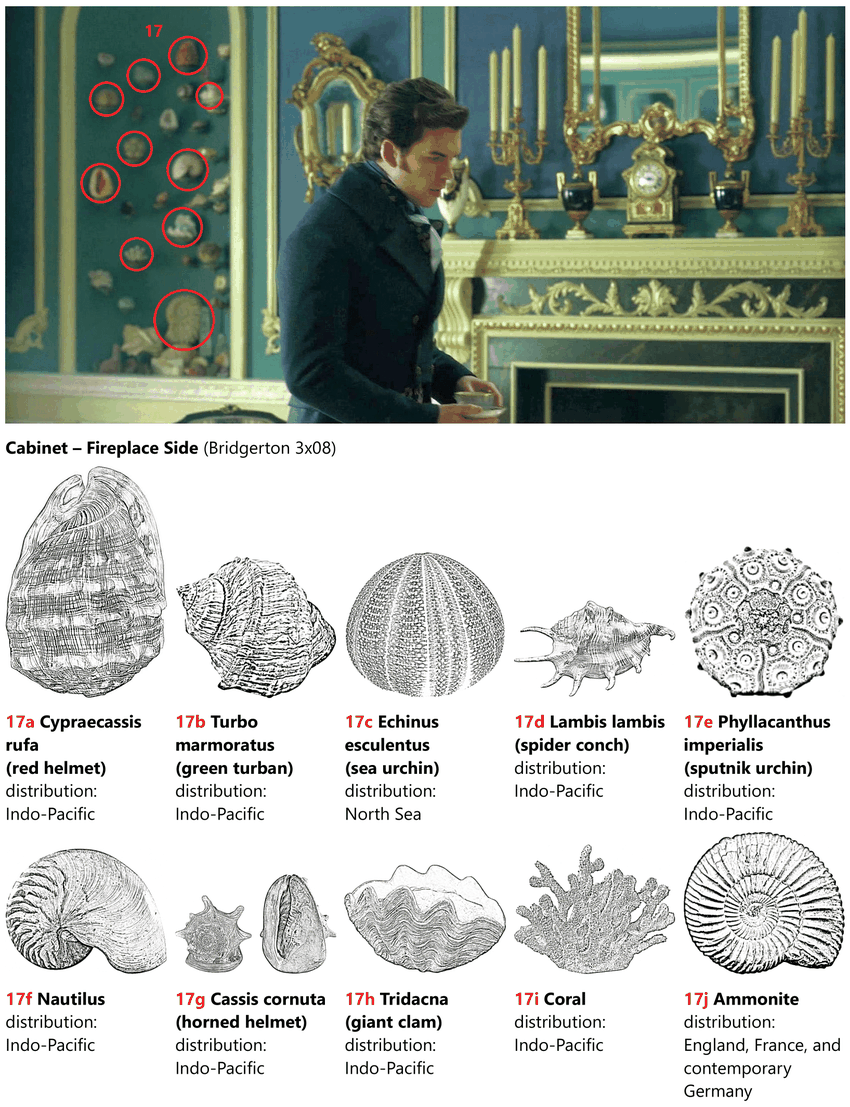
The objects 17a-17j are naturalia. I specifically selected these to demonstrate that, in addition to a few local naturalia (objects 17c and 17j), Colin's Grand Tour Collection primarily consists of exotica. Most of these originate from the Indo-Pacific. However, this does not necessarily mean that Colin travelled to that region during his Grand Tours; rather, he must have visited one of the three major port cities (Amsterdam, Marseille, Venice) where exotic naturalia from overseas were traded at the time.
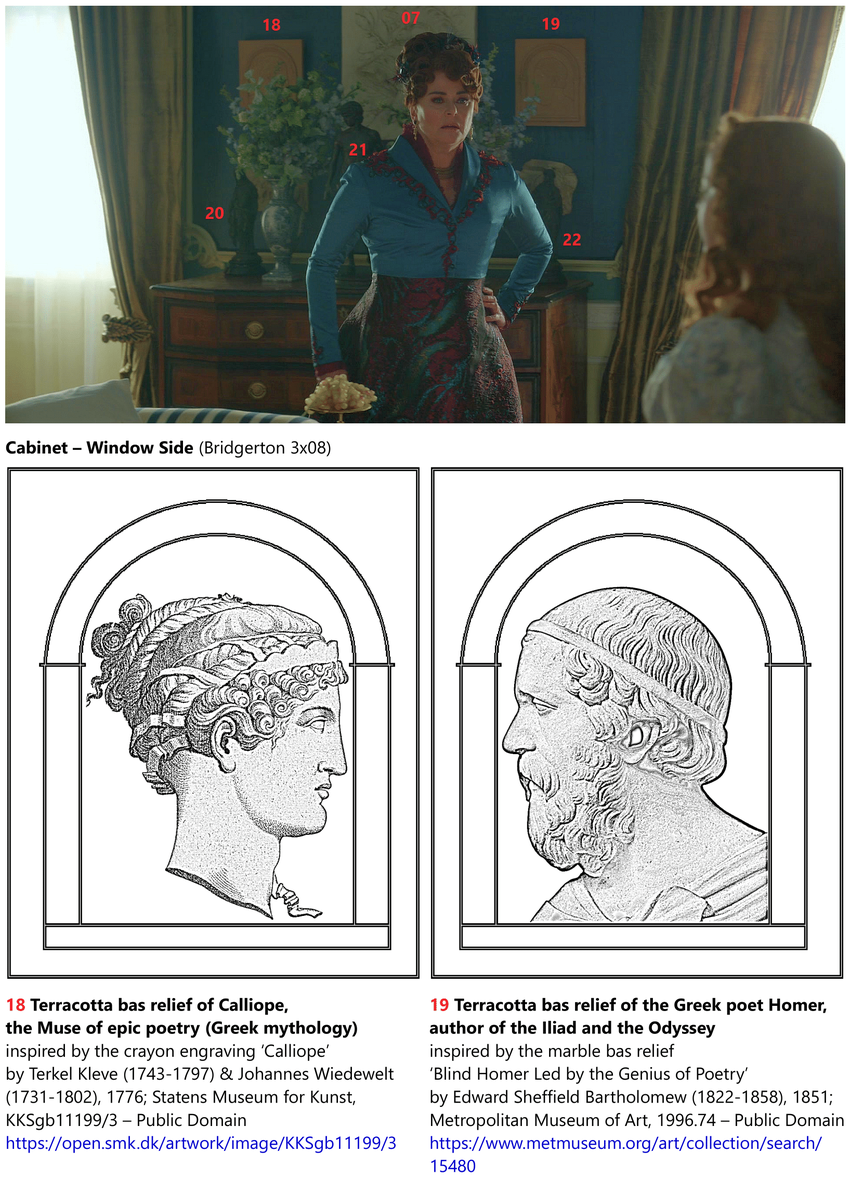
The objects 18 and 19 are artificialia that further illustrate Colin's affinity for Greece. However, they do not provide any concrete information about his whereabouts during his Grand Tours.
That is why it is more interesting that they indicate that Colin had a passion for literature and writing even before returning from his second Grand Tour, as the objects 18 and 19, two reliefs, depict Homer (circa 8th century BCE), one of the most famous writers of ancient Greece, and his Muse Calliope. Object 19 is another anachronism, as the artist Edward Sheffield Bartholomew did not create the relief of Homer until 1851. However, similar depictions of Homer existed earlier, so this discrepancy is negligible.
Between these two reliefs hangs an identical version of the relief symbolising peace (see image 09, object 07). All three reliefs are located in the cabinet, where only casual guests and close family members were invited. Therefore, we can assume that they hold particular personal significance for Colin.
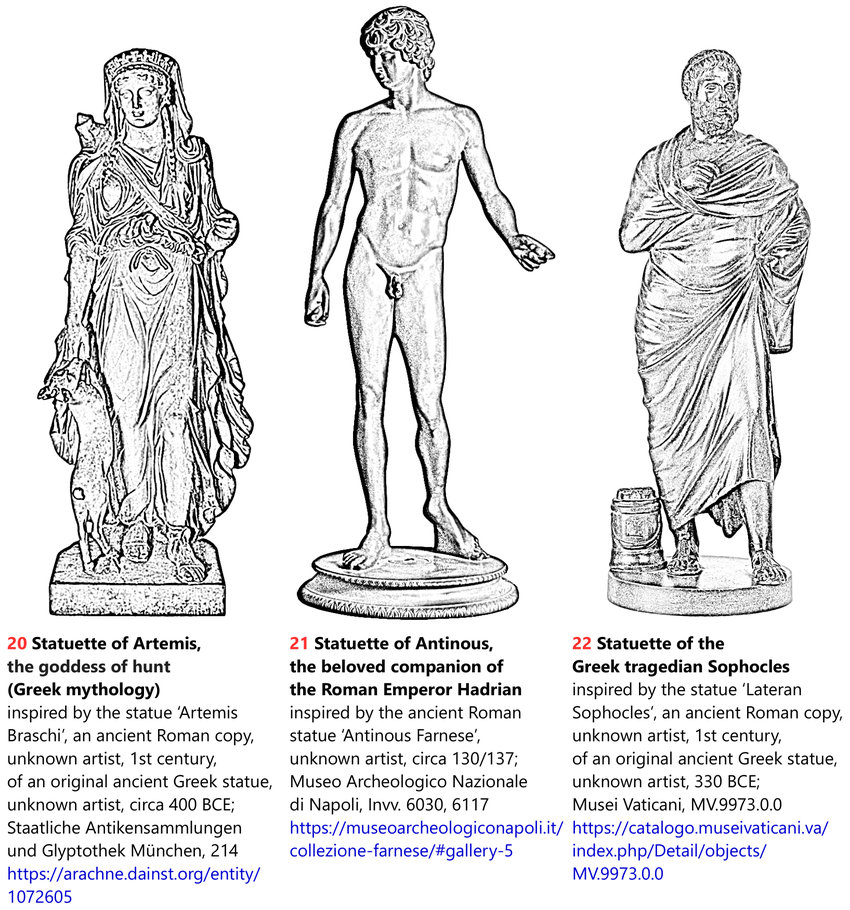
The objects 20-22 are artificialia. The three statuettes positioned beneath the reliefs on the window side of the cabinet reveal significant insights about Colin.
In object 22, a statuette of Sophocles (497-405 BCE), we encounter another important writer of ancient Greece – further evidence of Colin's admiration for Greece on the one hand and for literature and writing on the other hand.
The fact that, with object 21, Colin owns a statuette of Antinous (111-130), along with a bust of Antinous (see image 18, object 39), is intriguing for several reasons. Antinous was a Greek youth. Officially, he is described as the (beloved) companion of the Roman Emperor Hadrian (76-138), but unofficially, it was always understood that he was Hadrian's lover. After Antinous's untimely death before his 20th birthday under circumstances that remain unexplained, Hadrian elevated him to the status of a god. Hadrian's particular admiration for the Greek Antinous led to his deep fondness for ancient Greece and its culture – a sentiment known as philhellenism. Philhellenism experienced a revival in the early 19th century, and its adherents – including figures such as Lord Byron (1788-1824) – advocated, among other causes, for Greece's independence from the Ottoman Empire. Those who owned and displayed depictions of Antinous not only signaled that they were philhellinists but also expressed a certain openness towards homosexuality – not necessarily in practice but in terms of acceptance. Finally, the possession of this statuette of Antinous suggests that Colin spent time in Naples, where such statuettes were mainly offered in the early 19th century.
Object 20, the statuette of Artemis, further highlights Colin's appreciation for strong women, as Artemis was one of the most powerful and independent goddesses in Greek mythology. She was the goddess of the hunt, the wilderness, childbirth, and the moon, and was worshipped as the protector of women and children.
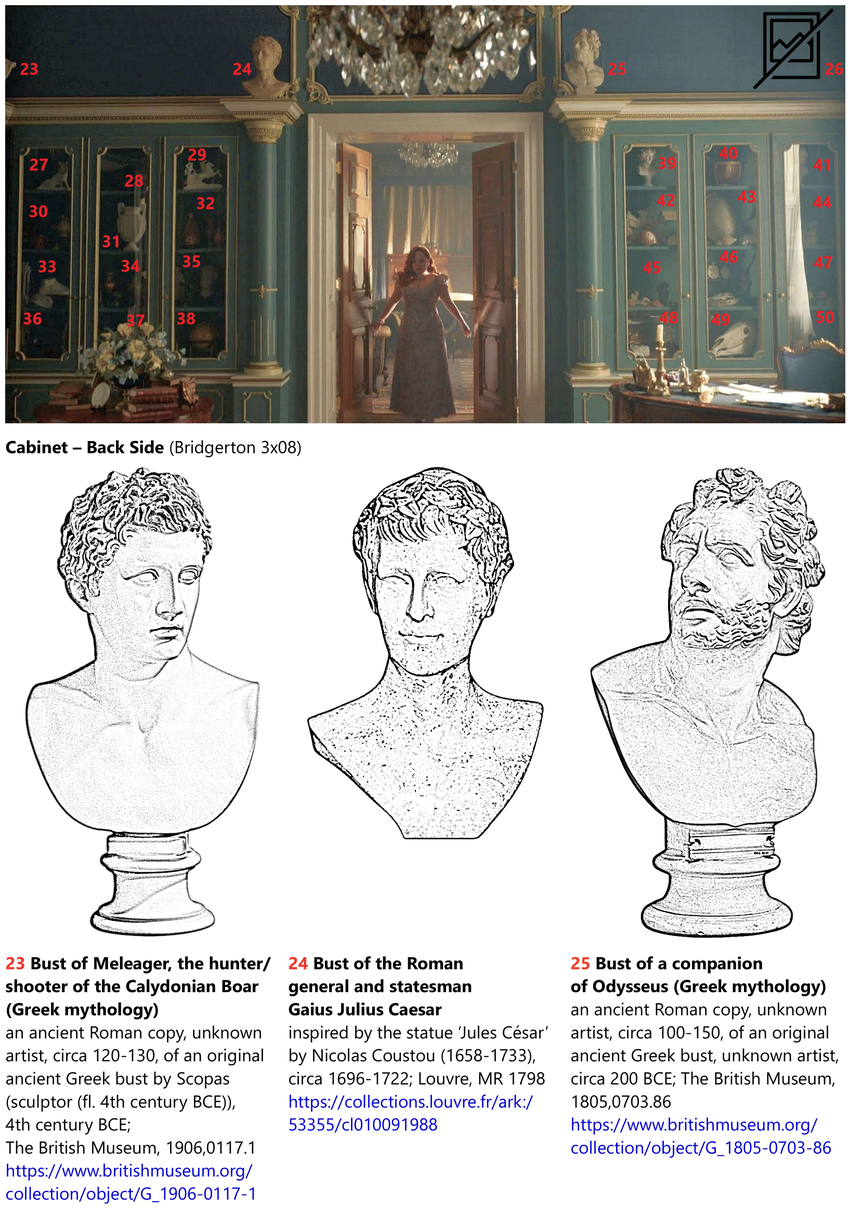
The busts 23-25 are artificialia. They further attest to Colin's stay in Greece, where he likely acquired the objects 23 and 25, while object 24 points to Paris, where busts of Caesar, such as object 24, became particularly popular from the late 18th century onward due to Napoleon I (1769-1821) and his admiration for the ancient Roman general and statesman Julius Caesar (100-44 BCE).
Object 25, a bust depicting a character from Homer's Odyssey, confirms Colin's love of literature and writing in general – and his love of Homer's works in particular (see image 14, objects 18 and 19).
Object 23 (see image 11) is a bust depicting Meleager, the hunter and shooter of the Calydonian boar in Greek mythology. The possession of this bust reinforces the impression that another object in Colin's home, namely object 27, a sculpture depicting the Calydonian boar (see image 17, object 27), holds particular personal significance for Colin. Object 27 is the only Grand Tour collectible in Colin's new home we know he owned before his first Grand Tour (see image 05). It is therefore conceivable that object 27 was a Grand Tour collectible and a gift from his father that Colin could not bear to leave behind at Bridgerton House for sentimental reasons.
Object 26 is a bust, the base of which is only briefly visible at the beginning of episode 3x08. No other sources, such as stills and BTS material, showing this bust could be found. Therefore object 26 is not identifiable.
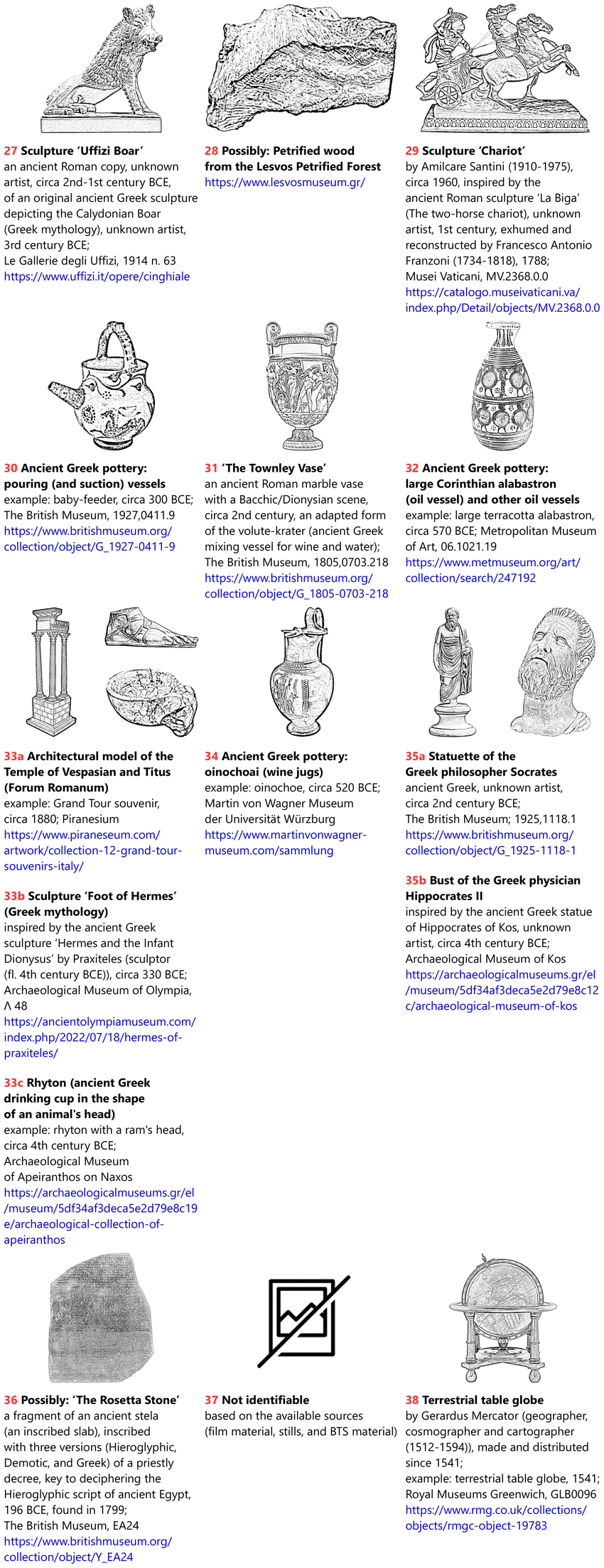
Object 37 is unidentifiable for the same reasons as object 26. Object 28 is likely a naturale, and object 38 is a scientificum. Otherwise, the objects 27-38 in the left display case at the back of the cabinet are artificialia.
I have already commented on object 27, the Uffizi boar, which represents the Calydonian boar, in connection with object 23, the bust of Meleager.
Object 28 is not clearly identifiable. However, based on its size, color, and structure, my research suggests that it could be a piece of petrified wood from the Lesvos Petrified Forest. Since we know from Colin's conversation with Sir Philip Crane that Colin visited Lesvos during his first Grand Tour (Bridgerton 2x04), this assumption does not seem far-fetched.
Object 29 is the most striking anachronism in Colin's Grand Tour Collection, as it is a sculpture of a chariot from circa 1960. However, since the sculpture is based on an ancient Roman sculpture whose rediscovery was a sensation in 1788, the historical inaccuracy is forgivable.
The objects 30, 31, 32, 33c, and 34 are ancient Greek and Roman pottery. These could equally be original artefacts in Colin's Grand Tour Collection or replicas crafted for Grand Tourists.
Object 33a, an architectural model of a ruin from the Forum Romanum, and object 33c, the sculpture ‘Foot of Hermes’, are unmistakably Grand Tour souvenirs of the kind, that was widely available in Rome (object 33a) and Athens (object 33c) at the beginning of the 19th century.
Object 38 is a typical scientificum. It is a globe which Colin likely purchased in London, just like object 05, the historical map (see image 08, object 05).
The objects 35a, 35b, and 36 suggest that Colin sees himself as a critical thinker who is open to scientific and medical advancements. Object 35a is a statuette of Socrates (469-399 BCE), founder of Western philosophy and famous for his Socratic method, object 35b is a bust of Hippocrates II (circa 460-370 BCE), father of systematic medicine, and object 36 is presumably a replica of the Rosetta Stone, which, soon after its discovery in 1799, proved to be one of the most significant breakthroughs in the history of epigraphy. However, my identification of object 36 as the Rosetta Stone remains an educated guess. Based on the available sources, it could also be a different black inscribed slab or a smooth black stone with engravings.
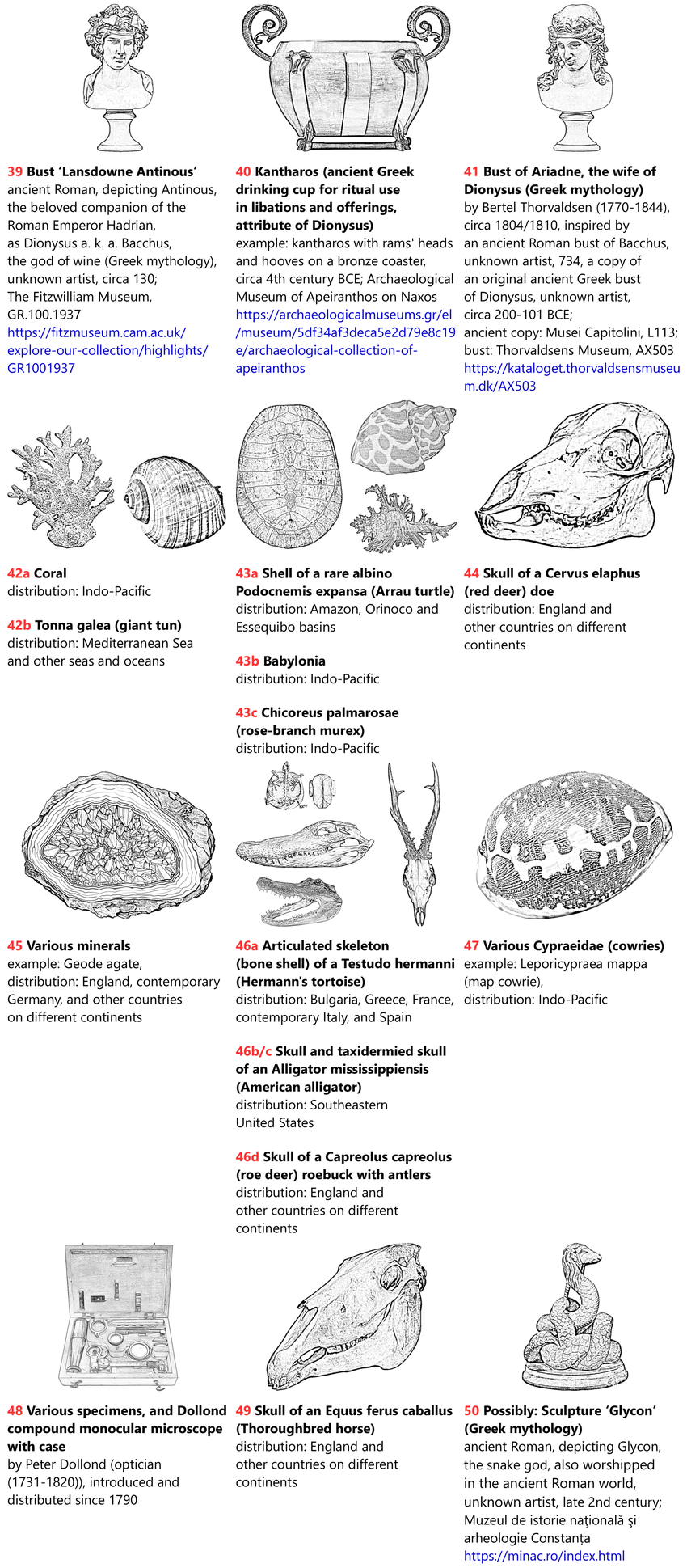
Object 48 is a typical scientificum, while the objects 39-41 and likely also object 50 are artificialia. Otherwise, the objects 39-50 in the right display case at the back of the cabinet are naturalia.
I have already commented on the significance of owning a representation of Antinous in connection with object 21. In object 39, a bust, we encounter Antinous once again, this time embodying Dionysus, the Greek god of wine. Object 40, a kantharos, an attribute of Dionysus, and object 41, a bust of Ariadne, Dionysus's wife, are closely linked to the god of wine, both spatially and thematically. Who, like Colin, owned such a multitude of artificialia with Dionysian references can be assumed to be at peace with themselves acting not only according to the Apollonian (rational) principle but also, on occasion, according to the Dionysian (chaotic) principle.
The naturalia are objects from England and Europe (objects 42b, 44-46a, 46d, and 49) as well as exotica from overseas (objects 42a, 43a-43c, 46b/c, and 47). What was already true for the objects 17a-17j also applies to these exotica: Colin likely acquired them in Amsterdam, Venice, or Marseille.
Object 44, a skull of a red deer doe, and object 46d, a skull of a roebuck, could be Colin's hunting trophies, while object 49, a horse skull, might be a memorabilia of a particularly beloved animal. This interpretation would suggest a sentimental disposition. However, Colin's reaction to Lord Basilio's grief over his horse does not necessarily support this assumption. Therefore, the horse skull may have simply been acquired and added to the Grand Tour Collection for study purposes.
Object 48 is a Dollond microscope, crafted by the same inventor and manufacturer as object 04, the Dollond telescope (see image 08, object 04). Like the telescope, Colin likely purchased the microscope in London.
I am not entirely certain about the identification of object 50. It was visible only briefly and only partially. It is either a taxidermy specimen of an unidentifiable yellow snake – which would classify object 50 as a naturale, aligning it with the other naturalia – or it is the sculpture ‘Glycon’, representing the ancient Greek snake god. In the latter case, it would belong to Colin's numerous other artificialia from Greece.
Bedchamber
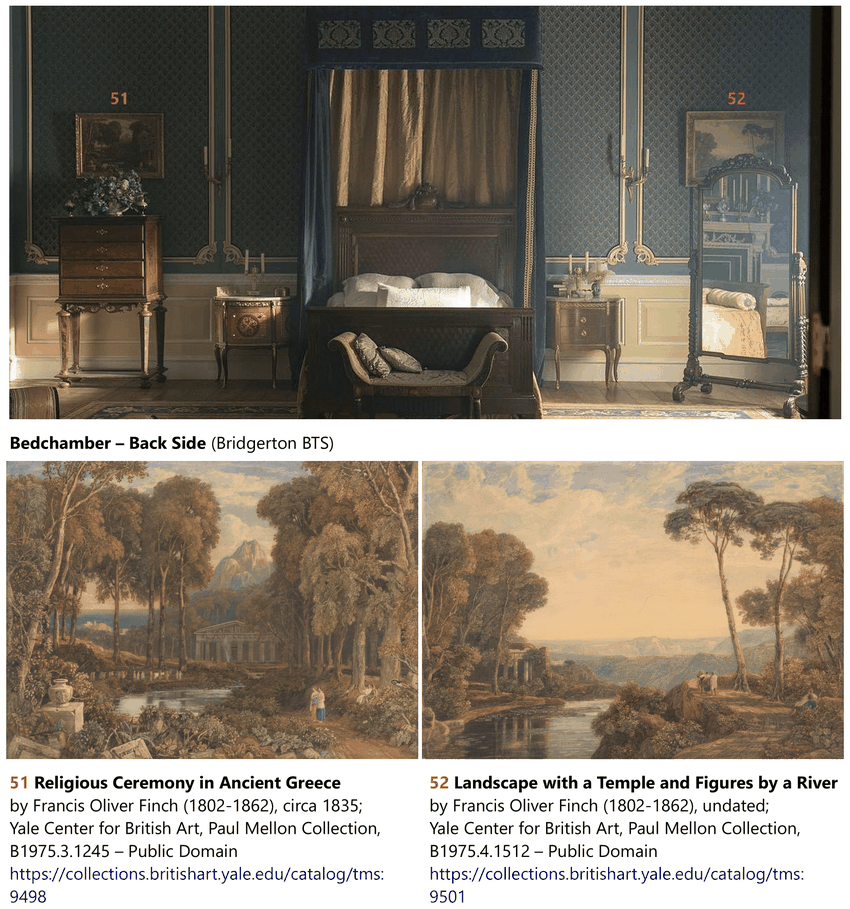
With the objects 51, 52 (see image 19), and 53 (see image 20), there are three additional artificialia in Colin's bedchamber that can be considered part of his Grand Tour Collection.
The objects 51 and 52 are paintings depicting ancient Greek landscapes. These two paintings are the last anachronisms in Colin's Grand Tour Collection. They were created approximately 20 years after Colin's return from his second Grand Tour, yet they capture the style of typical early 19th-century landscape paintings and can therefore be interpreted as contemporary neoclassical works of art – the kind often purchased by individuals with an affinity for Greece around 1815.
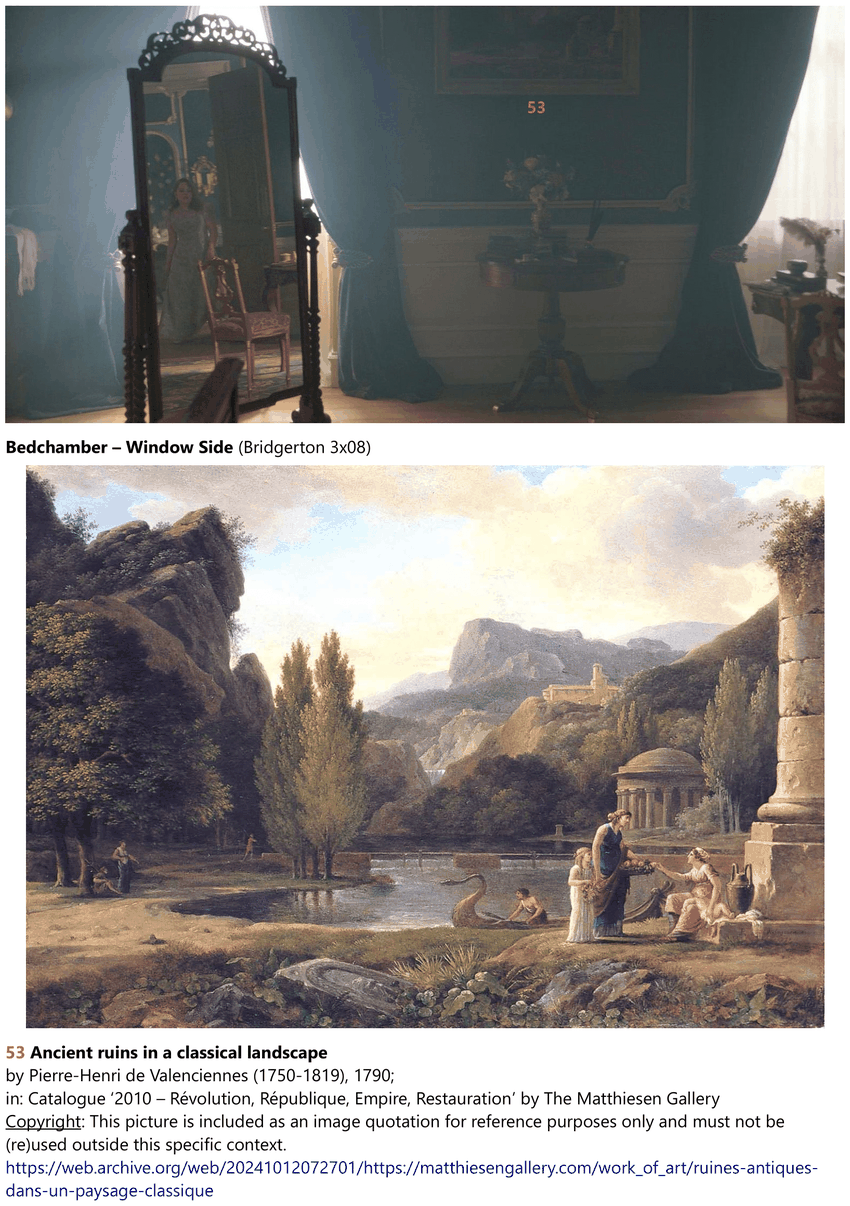
This is evidenced by object 53 (see image 20), a similar painting in both motif and style from 1790. The painting is briefly fully visible in the background during the so-called Bridgerton Ride. The three paintings in the bedchamber do not reveal anything about Colin or his travels that we have not already learned from his other Grand Tour collectibles.
Conclusion (tl;dr):
Although the in-depth examination of Colin's Grand Tour Collection does not reveal any new insights about his travel route, it does confirm his statements regarding his destinations and provides valuable information about him as a person.
Here is a summary of my research findings:
Colin's Grand Tour Collection indicates that he visited the following places on at least one of his two Grand Tours:
- France (Paris, Marseille)
- Greece (Lesvos, Athens)
- Present-day Italy (Florence, Rome, Venice, Naples)
- Possibly the Netherlands (Amsterdam).
Additionally, Colin exhibits the following characteristics:
- An appreciation for strong women
- A critical stance toward the repressive Christian sexual morality of the time
- Acceptance of homosexuality
- Positive memories of his late father, Edmund Bridgerton
- Occasional sentimentality
- An approach to life, guided not only by the Apollonian (rational) principle but occasionally also by the Dionysian (chaotic) principle
- Possibly a pacifist attitude
- A particularly strong admiration for ancient Greece – possibly even philhellenism
- A humanistic education
- An enthusiasm for writing and literature, especially the works of Homer and Sophocles
- Critical thinking
- Openness to scientific and medical advancements
- A preference for the scientific instruments of Peter Dollond
- A fascination with exotic naturalia from overseas.
Image attribution (unless indicated otherwise below the image):
- Bridgerton film material, stills, and BTS material, Copyright: Netflix / Shondaland. Included as image quotations for reference purposes only. Must not be (re)used outside this specific context.
- Drawn by u/sublimephantomtime (Carmen Krause). Please contact before (re)using outside this specific context.